

Last month I watched a film called Dear You at the Wanda cinema near Guomao in Beijing. It was good and it was sad. The theatre seemed unremarkable until I saw the QR code on the armrest and worked out that the seat could give a massage while the film played.
I left it alone for a while. My plan was only to watch a film. I had not even bought a snack. The chair looked like the sort of add-on that photographs better than it works, so the first half hour went by with it untouched and my arms folded across it.
Curiosity got me in the end. I scanned the code, paid a small amount, and the next two hours turned into the best time I had spent in a cinema in years. The massage was wonderful even though the film was sad, and within a minute my earlier verdict looked ridiculous. I had inspected the seat, dismissed it, and moved on, all before the one piece of information that mattered had arrived.
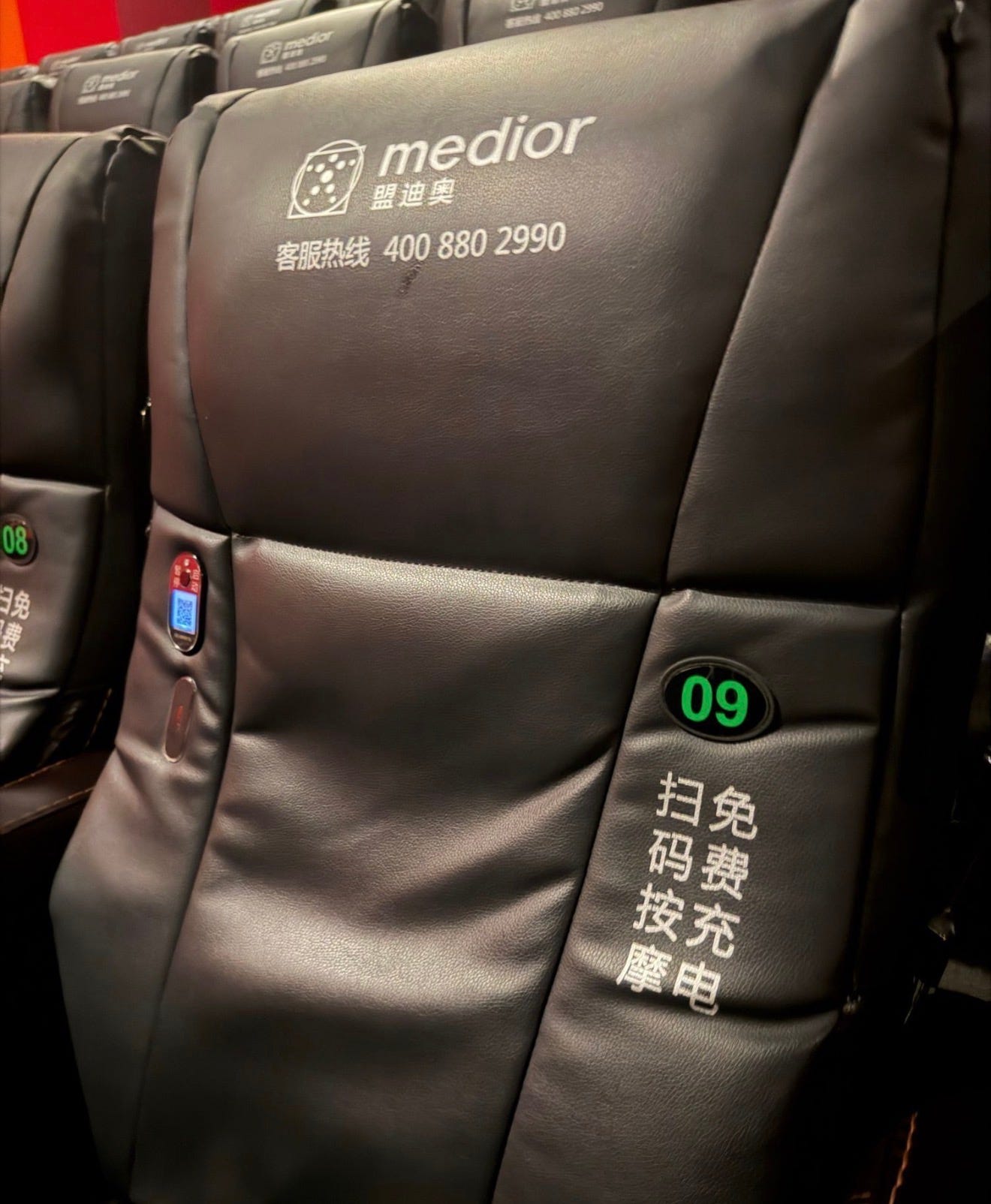
The message chair that I tried in the cinema.
The American economist Phillip Nelson described this in 1970, in a paper for the Journal of Political Economy. A few things can be judged before purchase, just by looking: the screen size, the price, the number of seats in the row. Nelson called those search goods. Most of what we care about resists that kind of inspection. A film, a meal, a chair with a QR code on it, none of them give up their worth until they have been used, and those he called experience goods. The value is genuine, and it stays out of reach until the thing is used.
We treat the second kind as if it were the first, because there is no time to do otherwise. Nobody can test every option, so we read the label and move on. Usually it is close enough. When it is not, the discovery comes late, after the money has changed hands, and never because the label lied. A label was never built to carry the part that only shows up in use.
A wrong guess about a massage chair costs a few yuan. A wrong guess about money costs a great deal more.
Risk tolerance is one of these hidden things. It cannot be read off a form in advance, because what is being judged is not a product at all. It is how a person will behave, and nobody can inspect a reaction they have not had yet.
Consider the risk questionnaire that comes before most advised investments. It asks how a person would feel if the portfolio fell twenty percent, and offers three boxes: sell, hold, buy more. Most of us tick the one that matches the investor we believe we are.
A real fall carries something no box can hold. The number is the easy part. What a form cannot record is the slowness: months of the balance sliding, no floor in view, the private suspicion that this time it does not come back. A questionnaire captures the investor we picture on a calm afternoon. A long decline hands the portfolio to the one who has to sit inside it while it is still falling, and the two are not always the same person. The size of the drop was never the real test. The length was, and so was the not knowing when it would end. A form has nowhere to put that.
So a person arrives holding a guess about how they will cope, and the guess usually ends up running the money. One investor decides in advance that a crash would be unbearable and holds cash for years, on the strength of a feeling that has never once been tested against a real fall.
It runs the other way too. Another ticks buy more and means it, then meets a real decline of the slow shapeless kind, and by the third month is moving money somewhere safer. Neither one lied on the form. Both were describing a person they had not met.
Here the cinema stops being a useful guide. A massage costs a few yuan and stops the moment it stops being wanted. A market fall does neither. Living through a thirty percent decline is an expensive way to learn how thirty percent feels. Some lessons are cheap enough to buy on a whim, and the whim repays itself in knowledge. This one is not. So people look for cheaper ways to find out: a smaller first step, a slower pace, someone’s account who has already been through a fall.
When the film finished, the lights came up, and the rest of the row filed out. I stayed where I was and let the chair run down the time I had paid for. I had over-purchased. It was worth every yuan.
This article is for education only. It does not take account of individual circumstances and is not financial advice.